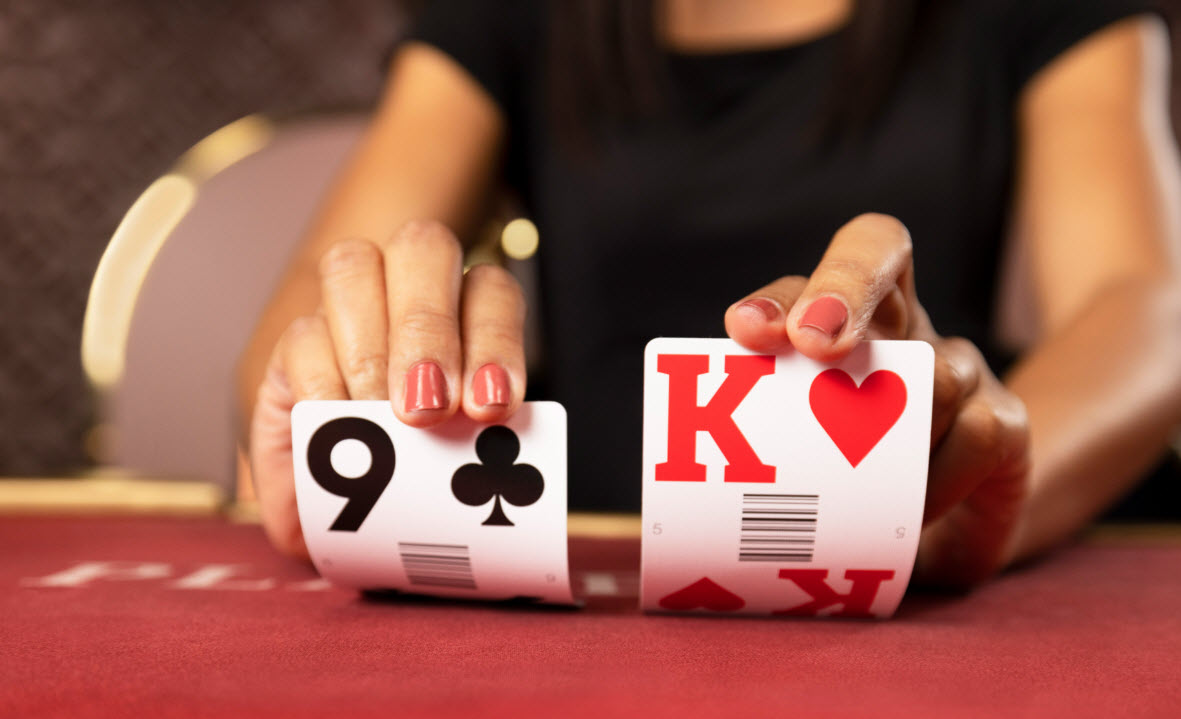
AI baccarat tools promise high “hit rates” and pattern prediction, but they operate on top of a game whose rules and payouts already lock in a small advantage for the house. Even if software helps track results and impose discipline, it cannot rewrite the underlying probabilities, so claims of near‑guaranteed profits on UFABET168 conflict with how baccarat is designed to function.
Why baccarat’s structure limits any AI system
Baccarat outcomes follow fixed drawing rules for Player and Banker hands, and cards are shuffled to approximate randomness, whether dealt by a live dealer or electronic shoe. Because the pay tables are slightly unfavourable to players—Banker carrying roughly a 1.06% house edge and Player around 1.2–1.3%, with Tie far worse—every bet begins with negative expected value that does not vanish because past results are analysed. Any AI system that only observes visible shoe history is still reacting to a stream whose future draws are, by design, independent of its previous public outcomes.
What AI baccarat predictors actually do in practice
Commercial baccarat AI tools tend to perform three main tasks: record past Banker/Player/Tie outcomes, detect simple streak or “chop” patterns, and output suggestions or confidence scores for the next hand. Marketing claims show figures such as “98% accuracy,” “consistent +3–5 units per shoe,” or “never had a losing session,” often backed by user testimonials rather than independent verification. Underneath, many of these systems appear to blend basic pattern recognition with money management rules, so perceived success often reflects selective conditions and short samples rather than a fundamental change in probabilities.
Once inputs are limited to public shoe data, no algorithm—AI or otherwise—can reliably foresee card sequences in a fair game beyond what the house edge already encodes. High reported win rates can arise from counting pushes as “non-losses,” picking specific segments of play, or recommending many no‑bet situations, which distorts how often suggested bets actually win.
How claims of very high win rates conflict with house edge
When a system advertises 90–99% win rates or “unbeatable” strategies, it is effectively suggesting that a negative‑expectation game has been turned into a positive‑expectation one purely through bet selection. Yet baccarat’s house edge figures—around 1–1.5% on the main bets and roughly 14% on Tie at 8:1—are derived from exhaustive combinatorial analysis of all possible deals, not from assumptions about player skill. To overcome that edge, a predictor would need either secret information about future cards or a structural change in payouts, neither of which is provided by ordinary pattern‑tracking apps.
Even when streak‑based systems appear to work temporarily, their long‑run results revert toward the negative expectation defined by the payout table, especially once a large number of hands is played. The more a player relies on advertised accuracy figures without asking how many bets were made and how results were measured, the more likely they are to misinterpret variance as proof of a permanent edge.
Where UFABET fits into the AI‑tool discussion
Players who already enjoy baccarat on a regular basis sometimes look for external tools to bring order to what feels chaotic. Under those conditions—where someone uses AI predictors mainly for logging outcomes, imposing bet limits, or deciding when to sit out—a service like UFABET functions as the underlying casino infrastructure on which those habits are executed, hosting the tables, dealing rules, and financial settlement. The mathematics of Banker, Player, and Tie bets remain governed by the casino’s rule set regardless of any third‑party app running on a phone beside the table.
From a risk perspective, this means that the true decision is not whether AI can “beat” UFABET, but whether the player can use software to support more disciplined behaviour inside an environment where the odds are fixed. If an app nudges a user to play fewer hands, avoid Tie, and stop after a set profit, it may improve outcomes relative to impulsive play, yet the underlying house edge still shapes long‑term expectations.
When AI support can still offer practical benefits
Although no predictor can guarantee profit against a mathematically tilted game, structured tools can nonetheless change certain behaviours in ways that soften losses. Pattern‑logging apps can encourage players to pause and think before each bet, which indirectly reduces reckless staking and emotional chasing. Some software also tracks win–loss sequences and bet sizes, giving users visibility into how quickly stakes escalate when progressions are used—insight that many only gain after painful experience.
By imposing rules—only betting in specific shoe states, limiting hand count, or capping daily loss—AI tools can serve as external discipline aids. However, these benefits come from better bankroll and session management, not from any secret predictive power over card outcomes, so they should be judged by how they affect behaviour, not by promises of statistical domination.
Comparing AI “systems” with simpler strategic choices
When stripped of advertising language, most expert advice on baccarat still converges on basic strategic points. Focusing on Banker or a mix of Banker and Player while avoiding Tie minimises the house edge; keeping stake sizes modest relative to bankroll limits how quickly negative variance can cause serious damage; and fixed or gently varying bet sizes tend to be safer than aggressive martingale‑style progressions. AI systems that do nothing more than dress these ideas in interface and charts cannot outperform them in expectation; they simply present traditional prudence in a more modern wrapper.
On the other hand, AI packages that combine high‑confidence predictive claims with aggressive staking advice—raising units sharply in “favourable” spots—can end up amplifying risk by pairing a negative‑edge game with volatile bet sizing. In those cases, the sophistication of the interface may hide the fact that the core approach is mathematically weaker than basic flat betting on the lowest‑edge wagers.
Why AI baccarat tools often fail at the psychological level
Baccarat already plays on perceptions of streaks, momentum, and “table flow,” and AI predictors can reinforce these intuitions by putting scientific‑sounding labels on them. When an app reports confidence ratings or success percentages, players may feel licensed to override their own limits, staked on the belief that technology has neutralised the house’s advantage. That psychological leverage can be more dangerous than the raw predictions themselves, because it nudges users toward riskier behaviours they might otherwise avoid.
Once a player believes that a given tool can produce “profit every shoe” or “no losing session,” losing streaks are more likely to be blamed on bad luck that must soon reverse, which fuels additional deposits and higher stakes. This pattern—the belief in a near‑certain edge combined with normal random downswings—is exactly the situation that harms bankrolls fastest, regardless of how advanced the graphics or algorithms behind the system appear.
Interaction with broader gambling behaviour, including casino online play
AI baccarat tools do not exist in isolation; they operate within wider gambling environments that may include sports betting, slots, and other high‑volatility games. When a player moves between baccarat sessions and other activities within the same ecosystem, short‑term results in one area can trigger compensating behaviour in another, eroding any discipline that AI might be supporting at the table. For example, a perceived “edge” in baccarat might encourage someone to risk freeroll profits in unrelated games, or losses elsewhere may prompt them to lean harder on AI predictions as a way to recover quickly.
To maintain any benefit from analytical tools, it helps to compartmentalise: treat baccarat sessions, including those using AI, as distinct from other forms of gambling, with separate budgets and time windows. When that separation is not observed, the promise of refined decision‑making in baccarat can be drowned out by impulsive choices across the wider casino environment.
Summary
AI baccarat “formulas” can assist with record‑keeping, structure, and self‑imposed rules, but they cannot overturn the house edge that defines Banker, Player, and Tie bets on เล่นบาคาร่า. Tools that promise extremely high win rates or guaranteed daily profit conflict with established analysis of baccarat odds and rely heavily on marketing narratives rather than transparent, long‑term evidence. When AI is treated as a support for discipline rather than as a shortcut to beating the game, and when play is kept within strict bankroll and session limits, it can fit into a more controlled approach—but the underlying reality remains that baccarat is a negative‑expectation game, and no predictor can reliably turn it into a source of assured profit.